Here's our final film and our making of. Let us know what you think!
Film:
Making Of:
Wednesday, 25 February 2009

Sorry
Has been a while since we've updated.
Good news though, we're basically finished! :)
We managed to take out the awful-looking shaky footwork from the attempts at a tracking shot, and it's been replaced with a few far more effective-looking shots of our stalker reading in his room. The film itself is now done, and we've filmed an "interview with the directors" style making-of documentary. We've also just finished the dvd menu, it's quite looks quite cool, keeping with the polaroids thing and the dark creepy music. (Even more new technology for us to use.)
All that's left to do is burn to dvd, get together the last of our paperwork from our planning stages together (although we do have most of our plans on here), and celebrate a great peice of coursework :)
Look out for us on youtube soon.
Good news though, we're basically finished! :)
We managed to take out the awful-looking shaky footwork from the attempts at a tracking shot, and it's been replaced with a few far more effective-looking shots of our stalker reading in his room. The film itself is now done, and we've filmed an "interview with the directors" style making-of documentary. We've also just finished the dvd menu, it's quite looks quite cool, keeping with the polaroids thing and the dark creepy music. (Even more new technology for us to use.)
All that's left to do is burn to dvd, get together the last of our paperwork from our planning stages together (although we do have most of our plans on here), and celebrate a great peice of coursework :)
Look out for us on youtube soon.
Thursday, 5 February 2009
Yay
Almost entirely done filming. Edited everything together (thought we were basically done) but discovered that the footage we have of someone walking looks horribly shaky (resuklt of trying to film it with a steady hand while walking backwards through mud in high heels) so we're taking it out and covering it with some other shots of our "stalker". Also means there's a bit more variety in our mise-en-scene, at the moent it's only going between two locations and looks kinda dull.
Sound edit's totally done, we ended up sticking with the first person we filmed for the voiceover. Sounds very scary, and he's got a credit in the peice so he's happy :)
We're also starting work on our evaluation, so keep your eyes peeled for our making of documentary. If anyone who reads this wants to add anything to it, or ask any questions of the films Directors/writers/producers/stars (basically us :)) let us know, we'll be using bits and peices from the blog.
Sound edit's totally done, we ended up sticking with the first person we filmed for the voiceover. Sounds very scary, and he's got a credit in the peice so he's happy :)
We're also starting work on our evaluation, so keep your eyes peeled for our making of documentary. If anyone who reads this wants to add anything to it, or ask any questions of the films Directors/writers/producers/stars (basically us :)) let us know, we'll be using bits and peices from the blog.
Saturday, 24 January 2009
Editing/filming ect
We finished filming everything on wednesday, however after we uploaded it all we discovered the shots of the feet were too shacky so we're goning to have to reshoot. Also, once we roughly put most of it together, we worked out it would be too short, so we've begun putting little flashes of the 'dark room' scene throughtout the begining that are going to be in black and white and will get longer as you get towards the end. Furthermore, this solves the problem of the images of the girl tied up being too shocking.
Hopefully, if Jo remembers my digisticks, we'll put the music on and whilst i'm in russia she'll film/record someone doing the vioceover so we can add that. (i like the idea of having a professional vioce doing the vioce over btw).
And if she does remember my digisticks then we can finally put some sample music on here and do the poll/audience research thing.
Hopefully, if Jo remembers my digisticks, we'll put the music on and whilst i'm in russia she'll film/record someone doing the vioceover so we can add that. (i like the idea of having a professional vioce doing the vioce over btw).
And if she does remember my digisticks then we can finally put some sample music on here and do the poll/audience research thing.
Monday, 19 January 2009
Preliminary task
So this is our preliminary task. Not great, but good learning experience considering Georgie and I are both new to this.
Taught us a lot of things. Was also our first experience of Garage band, you can probably tell we got a bit carried away. One thing we did realise is that the sound quality from the video recording is awful, which is why we'll be using a separate voiceover and none of the sounds from filming for our main task. Also realised that it's going to take us a long time to score any music to it, and it takes a while to edit. So it's got us working a bit faster.
Our filming's nearly all done. Corkboard/darkroom sequence will be done by the end of next week, and we've made a start on editing what we have so far. Voiceover's sounding good, had a few guys read it out. It's very likely it'll be my boss's voice on the final piece. Realised it might sound odd using someone from school, as we need a quite distinctive voice, and would rather people weren't just watching thinking "I know that voice".
Thursday, 15 January 2009
Voiceover
Working on the psycopaths monologue. This is the first draft, need to work it over with whoever ends up being the voice of our psycho. Any suggestions?
"You know the old adage, 'it takes 43 muscles to frown but only 17 to smile?' People really ought to smile a lot more. Smiling does a lot for you. A smile releases endorphins & painkillers, like a natural drug. A smile can denote pleasure, amusement, happinness, and a whole array of positive emotions. If you're smiling when you're down, it can cheer you up. It relaxes you, cheers you up, and is so much better for you than any other drug. Now, let's not forget the main one. Smiling can make an ordinary face light up. Make the most mindane of people seem interesting, different, can fascinate you. And for someone like her, smiling really does make you beautiful.I couldn't stop watching her after I saw that smile. The perfect curve of those pink lips in a way she can't hide. Her laughter and beauty are so much more obvious when she smiles.I can't help it if I need her, if I want her. It's really not my fault at all.I just had to see her smile."
"You know the old adage, 'it takes 43 muscles to frown but only 17 to smile?' People really ought to smile a lot more. Smiling does a lot for you. A smile releases endorphins & painkillers, like a natural drug. A smile can denote pleasure, amusement, happinness, and a whole array of positive emotions. If you're smiling when you're down, it can cheer you up. It relaxes you, cheers you up, and is so much better for you than any other drug. Now, let's not forget the main one. Smiling can make an ordinary face light up. Make the most mindane of people seem interesting, different, can fascinate you. And for someone like her, smiling really does make you beautiful.I couldn't stop watching her after I saw that smile. The perfect curve of those pink lips in a way she can't hide. Her laughter and beauty are so much more obvious when she smiles.I can't help it if I need her, if I want her. It's really not my fault at all.I just had to see her smile."
Wednesday, 14 January 2009

So this is our cork board which is the main focus of our film. We've been making stuff to put on it all week and i just stuck them on tonight. I've left a bit of a gap on the top right so he can stick the last polleriod on.
Hopefully we'll be filming all the dark room/ cork board things on saturday but we'll have to see if the polleriod film arrives in time.
Also we've taken the stills we wanted from the film we shot on sunday and Jo's going to photoshop them to make them look like polleriods this week so we have them for sunday (to add to the cork board).
Finally, i recorded a sample of some possible music but its a bit repetative and annoying but once we work out how (and make some other samples) we'll upload them onto here and have some audience research going. And we're writing/editing the vioce over Jo started today tomorrow.
 This is just a picture from our filming on sunday. This may feature in a making off documentary if we do one...
Sunday, 11 January 2009
location shoots


 This is the wall where the girl is going to be tied up (the Dark Room as it were).

Once i've cleared the wood... this could be a good corner to put the table and cork board


This one i took because its like the shots in The Bourne Ultimatam.
And this is the bench where the 'friendly gathering' will be/was.

Thursday, 8 January 2009
Prep task
Our prep task is completely finished now :)
We manage to film it in one day, it's all very basic. Editing was the hardest part but all the basic continuity's there. IT's all at a bit of a dutch angle, but if anyone asks, that was intentional :)
Scoring the music to it was difficult, neither of us have ever used garage band before. We got quite bored and probably put in more effects than we needed, but it came together pretty well.
Will upload it onto here later....once we work out how.
We manage to film it in one day, it's all very basic. Editing was the hardest part but all the basic continuity's there. IT's all at a bit of a dutch angle, but if anyone asks, that was intentional :)
Scoring the music to it was difficult, neither of us have ever used garage band before. We got quite bored and probably put in more effects than we needed, but it came together pretty well.
Will upload it onto here later....once we work out how.
Filming
We've now finished the shot list and story board. We're planning to shoot on sunday afternoon for the nowton stuff. (Our two locations are Nowton Park for the friends bits and My garage for the dark room and cork board things)
For sound we're planning to have our vioce over of the smile definitions. This needs to be in a male vioce and have pauses so we can hear the camera noises. Also we won't use the sound from the origional film as the laughter may make continuity difficult and distract from the vioce over, ruining the tension. But to add to the tension we're going to have a solo piano in minor playing.
Ps. We've sorted out the problem with the party scene and have now changed it to a friendly gathering in Nowton Park. Our location shots will be uploaded soon. And instead of a pan over Norwich, we're now going to do a hand held shot of our main guy's feet (1. concealment, 2. Like the shots at the begining of the Bourne Ultimatum) walking through the forest.
For sound we're planning to have our vioce over of the smile definitions. This needs to be in a male vioce and have pauses so we can hear the camera noises. Also we won't use the sound from the origional film as the laughter may make continuity difficult and distract from the vioce over, ruining the tension. But to add to the tension we're going to have a solo piano in minor playing.
Ps. We've sorted out the problem with the party scene and have now changed it to a friendly gathering in Nowton Park. Our location shots will be uploaded soon. And instead of a pan over Norwich, we're now going to do a hand held shot of our main guy's feet (1. concealment, 2. Like the shots at the begining of the Bourne Ultimatum) walking through the forest.
Saturday, 3 January 2009
Still needs to be done
- watch more examples - actually write them up
- finish the director profile - perhaps look at some more
- make an example cork board (i actually have one now) - post sum pics on the blog
- shot lists
- find out where we're going to shoot- i sumhow dnt think we'll be able to do the party thing - might have to come up with a solution.
Audience Research
These are the results from the printed questionnaires we handed out. Jo also put the questionnaire on some social network sites like facebook ect.
We mostly asked 16-17 year olds although we did also question some teachers and older family members.

Most people watched thrillers rarely or 'occasionally'
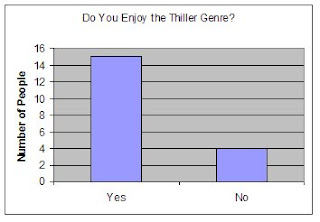
Most people did enjoy the genre.
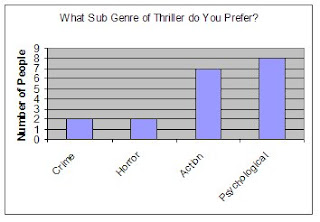
The majority of people we asked preferred to watch a psychological thriller although only 1 less person preferred to watch action movies.
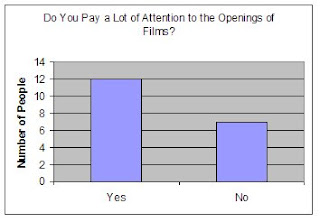
The audience research showed that openings are important to the people we asked.
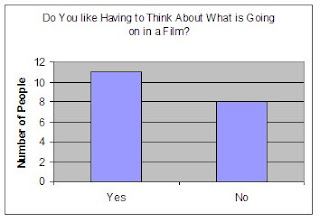
The majority of people did like to think about what going in a the narrative of a film in comparison to being 'spoon-fed' the plot.
Summary:
We mostly asked 16-17 year olds although we did also question some teachers and older family members.

Most people watched thrillers rarely or 'occasionally'

Most people did enjoy the genre.
The majority of people we asked preferred to watch a psychological thriller although only 1 less person preferred to watch action movies.

The audience research showed that openings are important to the people we asked.

The majority of people did like to think about what going in a the narrative of a film in comparison to being 'spoon-fed' the plot.
Summary:
- Thrillers are watched occasionally or rarely by 16-17 year olds
- Action and Psychological thrillers are preferred
- Openings are important as they can set the atmosphere and explain a film
- And most people our age prefer to think about the narrative of a film
Rough Story Board
Click on images to enlarge.


 We liked the idea of using poleriods in our film (like in momento) (hense why we want to call it smile) however, instead of being linked to memory we would use them to:
- draw attention to our main character
- represent the idea of stalking or watching someone
- and also as a creative way of putting our titles on.
To direct the film towards our target audience of 16-17 year olds we wanted to use a party scene at the begining but because of having to find a location and money ect this may be difficult. Solutions might be to just to have it as a kind of birthday party in a house of maybe just a scene where some friends have got together. The polleriods would gradually focus more and more on one girl until in the final polleriod you see her mouth taped up as though she's being held hostage.
Transistions would be rapid flash to white linked with a camera noise.
We also like the idea of the polleriods being pinned onto a cork board hopefully with lots of newspaper articles and other little things that might tell the story or at least give a few clues as to what kind of character the stalker might be and his relations to the girl.
The pictures could be made from stills of motion picture and photoshopped to look like a polleriods. And the titles will be hand written on the bottom of them.
Friday, 2 January 2009


Thursday, 1 January 2009
Brainstorming
We did have a short film of this but no one can get it to upload so I've just scanned all our planning stuff in as images instead.
Click images to enlarge.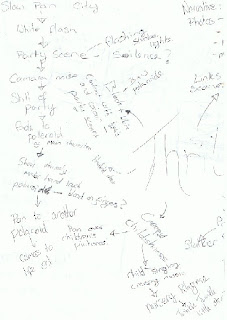
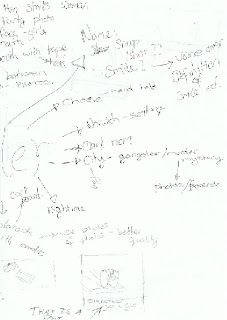
Some of the A3 stuff had to be scanned in two bits.
This is the first thing we did but its been gradually added to as time has gone on. (The arrows nearest the middle are the things we first thought of, the little arrows coming off some of them are expansions of the idea and generally the further out the arrow is the later we thought of it.)
Click images to enlarge.


Some of the A3 stuff had to be scanned in two bits.
This is the first thing we did but its been gradually added to as time has gone on. (The arrows nearest the middle are the things we first thought of, the little arrows coming off some of them are expansions of the idea and generally the further out the arrow is the later we thought of it.)
Monday, 15 December 2008
Smile
Georgie and I decided on having smiling as a theme for our peice, possibly using the word smile as a title. I've been doing some research, possibly to be used for a voiceover.
This is inspired by watching phone booth (a great example of a thriller) the other day. It starts with a voice over giving facts and figures about phone usage in the world. We wanted a similar thing here, a sort-of detached, scientific babbling to contrast with the tense, psycological aspects.
Smile
verb, smiled, smil-ing, noun
–verb (used without object)
1. to assume a facial expression indicating pleasure, favor, or amusement, but sometimes derision or scorn, characterized by an upturning of the corners of the mouth.
2. to regard with favor: Luck smiled on us that night.
3. to have a pleasant or agreeable appearance or aspect, as natural scenes, objects, etc.: The landscape smiled in the sunlight.
–verb (used with object)
4. to assume or give (a smile, esp. of a given kind): She smiled a warm and friendly smile.
5. to express by a smile: to smile approval.
6. to bring, put, drive, etc., by or as by smiling: to smile one's tears away. –noun
7. the act or an instance of smiling; a smiling expression of the face.
8. favor or kindly regard: fortune's smile.
9. a pleasant or agreeable appearance, look, or aspect.—Verb phrase
10. smile at,
a. to regard with pleasure or amusement, as with a smile.
b. to regard with mild derision: to smile at someone's affectations.
http://dictionary.reference.com/browse/smile
In physiology, a smile is a facial expression formed by flexing those muscles most notably near both ends of the mouth. The smile can also be found around the eyes (See 'Duchenne smile' below). Among humans, it is customarily an expression denoting pleasure, happiness, or amusement, but can also be an involuntary expression of anxiety, in which case it can be known as a grimace. There is much evidence that smiling is a normal reaction to certain stimuli as it occurs regardless of culture. Happiness is most often the motivating cause of a smile. Among animals, the exposure of teeth, which may bear a resemblance to a smile, is often used as a threat or warning display - known as a snarl - or a sign of submission. In chimpanzees, it can also be a sign of fear. The study of smiles is a part of gelotology, psychology, and linguistics, comprising various theories of affect, humor, and laughter.
http://en.wikipedia.org/wiki/Smile
Reasons to smile:
1. Smiling makes us attractive.
We are drawn to people who smile. There is an attraction factor. We want to know a smiling person and figure out what is so good. Frowns, scowls and grimaces all push people away -- but a smile draws them in.
2. Smiling Changes Our Mood
Next time you are feeling down, try putting on a smile. There's a good chance you mood will change for the better. Smiling can trick the body into helping you change your mood.
3. Smiling is Contagious
When someone is smiling they lighten up the room, change the moods of others, and make things happier. A smiling person brings happiness with them. Smile lots and you will draw people to you.
4. Smiling Relieves Stress
Stress can really show up in our faces. Smiling helps to prevent us from looking tired, worn down, and overwhelmed. When you are stressed, take time to put on a smile. The stress should be reduced and you'll be better able to take action.
5. Smiling Boosts Your Immune System
Smiling helps the immune system to work better. When you smile, immune function improves possibly because you are more relaxed. Prevent the flu and colds by smiling.
6. Smiling Lowers Your Blood Pressure
When you smile, there is a measurable reduction in your blood pressure. Give it a try if you have a blood pressure monitor at home. Sit for a few minutes, take a reading. Then smile for a minute and take another reading while still smiling. Do you notice a difference?
7. Smiling Releases Endorphins, Natural Pain Killers and Serotonin
Studies have shown that smiling releases endorphins, natural pain killers, and serotonin. Together these three make us feel good. Smiling is a natural drug.
8. Smiling Lifts the Face and Makes You Look Younger
The muscles we use to smile lift the face, making a person appear younger. Don't go for a face lift, just try smiling your way through the day -- you'll look younger and feel better.
9. Smiling Makes You Seem Successful
Smiling people appear more confident, are more likely to be promoted, and more likely to be approached. Put on a smile at meetings and appointments and people will react to you differently.
10. Smiling Helps You Stay Positive
Try this test: Smile. Now try to think of something negative without losing the smile. It's hard. When we smile our body is sending the rest of us a message that "Life is Good!" Stay away from depression, stress and worry by smiling.
http://longevity.about.com/od/lifelongbeauty/tp/smiling.htm
In reference to the old adage "It takes 43 muscles to frown and only 17 to smile":
I've been hearing this for years. Supposedly it takes fewer muscles to smile than to frown; ergo, you should smile. Happiness, it seems, is the lazy person's emotion. Time to put this platitude to rest. I arrived at the following detailed accounting of the relevant muscles with the aid of David H. Song, MD, FACS, plastic surgeon and assistant professor at the University of Chicago Hospitals. Song, among other things, reconstructs faces--in short, he ought to know. My apologies if this list seems obsessive, but we're going to settle this once and for all. Caveat: Deciding which of the 53 facial muscles are important in smiling or frowning is a bit arbitrary--many make only minor contributions, and depending on the intensity of the expression may not be involved at all. I've listed here the ones Song feels are important, as corroborated by other sources.
Muscles involved in a "zygomatic" (i.e., genuine) smile:
Zygomaticus major and minor. These muscles pull up the corners of the mouth. They're bilateral (one set on either side of the face). Total number of muscles: 4.
Orbicularis oculi. One of these muscles encircles each eye and causes crinkling. Total: 2.
Levator labii superioris. Pulls up corner of lip and nose. Bilateral. Total: 2.
Levator anguli oris. Also helps elevate angle of mouth. Bilateral. Total: 2.
Risorius. Pulls corner of mouth to the side. Bilateral. Total: 2. Grand total for smiling: 12.
Principal muscles involved in a frown:
Orbicularis oculi (again). Total: 2.
Platysma. Pulls down lips and wrinkles skin of lower face. Bilateral (though joined at midline). Total: 2.
Corrugator supercilii (bilateral) and procerus (unilateral). Furrow brow. Total: 3.
Orbicularis oris. Encircles mouth; purses lips. Unilateral. Total: 1.
Mentalis. Depresses lower lip. Unilateral. Total: 1.
Depressor anguli oris. Pulls corner of mouth down. Bilateral. Total: 2. Grand total for frowning: 11.
Despite the fact that smiling uses more muscles, Song believes it takes less effort than frowning--people tend to smile more frequently, so the relevant muscles are in better shape. You may feel this conclusion assumes a rosier view of the human condition than the facts warrant, but I defer to the doctor. Incidentally, a superficial, homecoming-queen smile requires little more than the two risorius muscles. So if your goal in expressing emotion is really to minimize effort, go for insincere.
http://www.straightdope.com/columns/read/2489/does-it-take-fewer-muscles-to-smile-than-it-does-to-frown
And I also found an excellent blog page on the subject.
http://anatomynotes.blogspot.com/2006/01/muscles-to-smile-muscles-to-frown.html
This is inspired by watching phone booth (a great example of a thriller) the other day. It starts with a voice over giving facts and figures about phone usage in the world. We wanted a similar thing here, a sort-of detached, scientific babbling to contrast with the tense, psycological aspects.
Smile
verb, smiled, smil-ing, noun
–verb (used without object)
1. to assume a facial expression indicating pleasure, favor, or amusement, but sometimes derision or scorn, characterized by an upturning of the corners of the mouth.
2. to regard with favor: Luck smiled on us that night.
3. to have a pleasant or agreeable appearance or aspect, as natural scenes, objects, etc.: The landscape smiled in the sunlight.
–verb (used with object)
4. to assume or give (a smile, esp. of a given kind): She smiled a warm and friendly smile.
5. to express by a smile: to smile approval.
6. to bring, put, drive, etc., by or as by smiling: to smile one's tears away. –noun
7. the act or an instance of smiling; a smiling expression of the face.
8. favor or kindly regard: fortune's smile.
9. a pleasant or agreeable appearance, look, or aspect.—Verb phrase
10. smile at,
a. to regard with pleasure or amusement, as with a smile.
b. to regard with mild derision: to smile at someone's affectations.
http://dictionary.reference.com/browse/smile
In physiology, a smile is a facial expression formed by flexing those muscles most notably near both ends of the mouth. The smile can also be found around the eyes (See 'Duchenne smile' below). Among humans, it is customarily an expression denoting pleasure, happiness, or amusement, but can also be an involuntary expression of anxiety, in which case it can be known as a grimace. There is much evidence that smiling is a normal reaction to certain stimuli as it occurs regardless of culture. Happiness is most often the motivating cause of a smile. Among animals, the exposure of teeth, which may bear a resemblance to a smile, is often used as a threat or warning display - known as a snarl - or a sign of submission. In chimpanzees, it can also be a sign of fear. The study of smiles is a part of gelotology, psychology, and linguistics, comprising various theories of affect, humor, and laughter.
http://en.wikipedia.org/wiki/Smile
Reasons to smile:
1. Smiling makes us attractive.
We are drawn to people who smile. There is an attraction factor. We want to know a smiling person and figure out what is so good. Frowns, scowls and grimaces all push people away -- but a smile draws them in.
2. Smiling Changes Our Mood
Next time you are feeling down, try putting on a smile. There's a good chance you mood will change for the better. Smiling can trick the body into helping you change your mood.
3. Smiling is Contagious
When someone is smiling they lighten up the room, change the moods of others, and make things happier. A smiling person brings happiness with them. Smile lots and you will draw people to you.
4. Smiling Relieves Stress
Stress can really show up in our faces. Smiling helps to prevent us from looking tired, worn down, and overwhelmed. When you are stressed, take time to put on a smile. The stress should be reduced and you'll be better able to take action.
5. Smiling Boosts Your Immune System
Smiling helps the immune system to work better. When you smile, immune function improves possibly because you are more relaxed. Prevent the flu and colds by smiling.
6. Smiling Lowers Your Blood Pressure
When you smile, there is a measurable reduction in your blood pressure. Give it a try if you have a blood pressure monitor at home. Sit for a few minutes, take a reading. Then smile for a minute and take another reading while still smiling. Do you notice a difference?
7. Smiling Releases Endorphins, Natural Pain Killers and Serotonin
Studies have shown that smiling releases endorphins, natural pain killers, and serotonin. Together these three make us feel good. Smiling is a natural drug.
8. Smiling Lifts the Face and Makes You Look Younger
The muscles we use to smile lift the face, making a person appear younger. Don't go for a face lift, just try smiling your way through the day -- you'll look younger and feel better.
9. Smiling Makes You Seem Successful
Smiling people appear more confident, are more likely to be promoted, and more likely to be approached. Put on a smile at meetings and appointments and people will react to you differently.
10. Smiling Helps You Stay Positive
Try this test: Smile. Now try to think of something negative without losing the smile. It's hard. When we smile our body is sending the rest of us a message that "Life is Good!" Stay away from depression, stress and worry by smiling.
http://longevity.about.com/od/lifelongbeauty/tp/smiling.htm
In reference to the old adage "It takes 43 muscles to frown and only 17 to smile":
I've been hearing this for years. Supposedly it takes fewer muscles to smile than to frown; ergo, you should smile. Happiness, it seems, is the lazy person's emotion. Time to put this platitude to rest. I arrived at the following detailed accounting of the relevant muscles with the aid of David H. Song, MD, FACS, plastic surgeon and assistant professor at the University of Chicago Hospitals. Song, among other things, reconstructs faces--in short, he ought to know. My apologies if this list seems obsessive, but we're going to settle this once and for all. Caveat: Deciding which of the 53 facial muscles are important in smiling or frowning is a bit arbitrary--many make only minor contributions, and depending on the intensity of the expression may not be involved at all. I've listed here the ones Song feels are important, as corroborated by other sources.
Muscles involved in a "zygomatic" (i.e., genuine) smile:
Zygomaticus major and minor. These muscles pull up the corners of the mouth. They're bilateral (one set on either side of the face). Total number of muscles: 4.
Orbicularis oculi. One of these muscles encircles each eye and causes crinkling. Total: 2.
Levator labii superioris. Pulls up corner of lip and nose. Bilateral. Total: 2.
Levator anguli oris. Also helps elevate angle of mouth. Bilateral. Total: 2.
Risorius. Pulls corner of mouth to the side. Bilateral. Total: 2. Grand total for smiling: 12.
Principal muscles involved in a frown:
Orbicularis oculi (again). Total: 2.
Platysma. Pulls down lips and wrinkles skin of lower face. Bilateral (though joined at midline). Total: 2.
Corrugator supercilii (bilateral) and procerus (unilateral). Furrow brow. Total: 3.
Orbicularis oris. Encircles mouth; purses lips. Unilateral. Total: 1.
Mentalis. Depresses lower lip. Unilateral. Total: 1.
Depressor anguli oris. Pulls corner of mouth down. Bilateral. Total: 2. Grand total for frowning: 11.
Despite the fact that smiling uses more muscles, Song believes it takes less effort than frowning--people tend to smile more frequently, so the relevant muscles are in better shape. You may feel this conclusion assumes a rosier view of the human condition than the facts warrant, but I defer to the doctor. Incidentally, a superficial, homecoming-queen smile requires little more than the two risorius muscles. So if your goal in expressing emotion is really to minimize effort, go for insincere.
http://www.straightdope.com/columns/read/2489/does-it-take-fewer-muscles-to-smile-than-it-does-to-frown
And I also found an excellent blog page on the subject.
http://anatomynotes.blogspot.com/2006/01/muscles-to-smile-muscles-to-frown.html
Thursday, 11 December 2008
Questionaire
If anyone's got some spare time do you think you could just fill this out? Just a bit of research. Thankyou! :) (use the comment thing at the bottom)
1) How often do you watch thriller films?
Once a week
Once a month
Other (please specify)
2) Do you enjoy the thriller genre?
Yes
No
3) What type of thriller do you prefer?
Crime
Horror
Action
Psychological
4) Do you pay alot of attention to the openings of films?
Yes
No
5) Do you like having to think about what's going on in a film?
Yes
No
1) How often do you watch thriller films?
Once a week
Once a month
Other (please specify)
2) Do you enjoy the thriller genre?
Yes
No
3) What type of thriller do you prefer?
Crime
Horror
Action
Psychological
4) Do you pay alot of attention to the openings of films?
Yes
No
5) Do you like having to think about what's going on in a film?
Yes
No
Wednesday, 26 November 2008
The Bourne Ultimatum
http://www.imdb.com/rg/VIDEO_PLAY/LINK//video/screenplay/vi2962161945/
The Bourne Ultimatum uses editing techniques such as rapid cuts, particularly in the chase sequences, to create a sense of urgency and panic. This is combined with the steady but fast pace set by the strings and drums during the opening sequence to enhance that atmosphere of a deadline. These musical techniques are particularly prominent in the scene where Noah Vosen is delegating tasks to his team in order to track Bourne and often crescendo as the pace of the chase picks up.
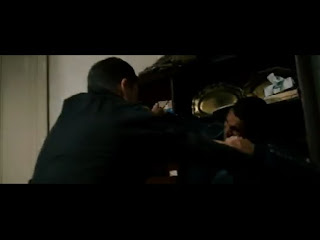 Another technique used to demonstrate how supirior he is, is the use of low angles in the fight scenes, especially when he is throwing the punches.
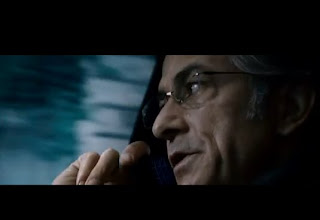 Following the conventions of thriller, the use of close ups, extreme close ups and telephones are all used to conceal identities and narrative. An example of this would be the scene where Dr. Albert Hirsch is speaking on the phone. Greengrass uses extreme close ups of his mouth and eyes to both conceal his identity and the identity of who hes talking to.
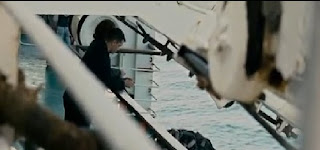 In other conversations, between Simon Ross and Neal Daniels the framing of the shots are dominated by the back of Simon, which give an impression that he's being watched. POV tracking shots, following Bourne, in the opening sequence are also dominated by other objects, making the audience feel as though we're watching or following him. These techniques are used throughout the film.


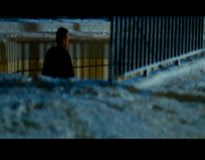 Moreover, CCTV style shots are used in the opening to follow Bourne. The high angle shot not only used to include the audience in the chase but also to demonstrate Bourne's disadvantage, being wounded.
 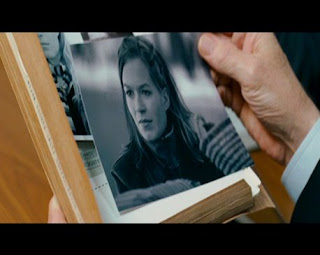 Mise-en-scene elements often associated with the Thriller genre are the hand Guns (used by almost every character), the police investigations and files, urban/exotic settings eg moscow and the use of lighting to cast shadows or over-expose flashbacks. All of these we would also associate with film noir and 'crime thrillers'.
The Bourne Ultimatum uses editing techniques such as rapid cuts, particularly in the chase sequences, to create a sense of urgency and panic. This is combined with the steady but fast pace set by the strings and drums during the opening sequence to enhance that atmosphere of a deadline. These musical techniques are particularly prominent in the scene where Noah Vosen is delegating tasks to his team in order to track Bourne and often crescendo as the pace of the chase picks up.
Dialogue such as "you are 9 hours behind the toughest target you have ever tracked' both suggests a deadline and demonstrates how impressive and extensive Bourne's abilities are. (http://www.imdb.com/video/screenplay/vi2190410009/)
 Another technique used to demonstrate how supirior he is, is the use of low angles in the fight scenes, especially when he is throwing the punches.
 Following the conventions of thriller, the use of close ups, extreme close ups and telephones are all used to conceal identities and narrative. An example of this would be the scene where Dr. Albert Hirsch is speaking on the phone. Greengrass uses extreme close ups of his mouth and eyes to both conceal his identity and the identity of who hes talking to.In other conversations, between Simon Ross and Neal Daniels the framing of the shots are dominated by the back of Simon, which give an impression that he's being watched. POV tracking shots, following Bourne, in the opening sequence are also dominated by other objects, making the audience feel as though we're watching or following him. These techniques are used throughout the film.

 Moreover, CCTV style shots are used in the opening to follow Bourne. The high angle shot not only used to include the audience in the chase but also to demonstrate Bourne's disadvantage, being wounded.
 High Angled Pans of urban city areas are often used as establishing shots by Greengrass to set the scene and show location. Prior to these shots, he uses a black screen with capitalised white writing on saying the place. This writing is accompanied by a typing noise, giving the film an atmosphere of a 'spy thriller'. However, although we hear the typing noise, the writing simply appears in a block instead of letter by letter as would be expected. This is unexpected as it contrasts with the rest of the film, where we usually hear before we see.
In the chase sequence at the beginning we firstly hear the diegetic sirens (which continue as a sound bridge), then see bourne turning to look behind him, and then the follow shot of the actual policemen, giving a sense of realism allowing the audience to immediately sympathise with the main character. Furthermore, this is extensive use of concealment. Other examples include, the use of the name 'BlackBriare' and 'the beginning'. These 'code' names are not explained but frequently used until late in the second half of the film, keeping the audience questioning and feeling as an 'outsider' (causing us to empathise with Bourne). Alienation of the main character is a common feature of Thrillers and is combined with memory loss.
Diegetic enhanced, sometimes off scene, sound is often used by Greengrass throughout the film to create tension and put the audience 'on edge'. Matched by some of the hand held camera work during the opening, this is very effective. Phones ringing off scene, and sound bridges continue the theme of hearing before seeing. Fast, loud, drumming noises whilst Bourne is chasing Desh, elevates the tension. Equally, the silence when Nicky Parsons is hiding from Desh is very effective in creating apprehension. Constantly, the music is used to create a deadline as does the narrative features of a bomb and the attempt to stop Bourne before he got the the training centre.
Diegetic enhanced, sometimes off scene, sound is often used by Greengrass throughout the film to create tension and put the audience 'on edge'. Matched by some of the hand held camera work during the opening, this is very effective. Phones ringing off scene, and sound bridges continue the theme of hearing before seeing. Fast, loud, drumming noises whilst Bourne is chasing Desh, elevates the tension. Equally, the silence when Nicky Parsons is hiding from Desh is very effective in creating apprehension. Constantly, the music is used to create a deadline as does the narrative features of a bomb and the attempt to stop Bourne before he got the the training centre.
Mise-en-scene elements often associated with the Thriller genre are the hand Guns (used by almost every character), the police investigations and files, urban/exotic settings eg moscow and the use of lighting to cast shadows or over-expose flashbacks. All of these we would also associate with film noir and 'crime thrillers'. However, The Bourne Ultimatum contradicts the Thriller conventions when it becomes unrealistic. for example, the motorbike being ridden up stairs, cars turning over, and characters jumping through windows from building to building are particularly exaggerated. This is when it crosses over to an 'action-spy-thriller'.
Student Examples
Third Floor
We liked the use of atmospheric strings in this opening. It matched the slow mo and created tension. Strings may be very effective in our opening.
Also, the use of Black and White flashbacks are very conventional of the genre and worked well in creating confusion and enigmas.
However, we felt it was almost too confusing with almost no continuity. Furthermore, the title at the end seemed rushed an out of place as they didn't match the titles at the beginning, and were in an unconventional order.
Re:Venge
We liked the CCTV style high angle camera work. It was like the main character was being watched. Also, the entire narrative created enigmas such as 'who is the man in the alleyway?'. Furthermore, the use of lighting to create silhouettes was very effect in concealing identity. We would like to try and use this in our film if possible.
However, there were too many shots of the suited man walking up the stairs, making it seem a little repetitive and boring. This was also added to by the repetitive music. Moreover, the unnecessary zooms used when characters were walking towards the camera took away from the professionalism.
Wednesday, 19 November 2008
Thriller conventions
Settings -
- Exotic eg. foreign cities, deserts, high seas
Characters -
- "Hard men" as hero's accustomed to danger,
- Policemen,
- Spies,
- Soldiers,
- Aviators,
- Ordinary citizens drawn into danger.
Narrative -
- Often overlap with mystery,
- Distinguished by structure of their plots,
- Hero thwarts plans of enemy,
- Grand scale : serial/mass murder, terrorism, assassination, overthrow governments.
- Violent confrontations,
- Hero often has to save their lives and other's,
- Modern films influenced by horror to heighten tension.
- Create a mood of fearful excitement.
- Twists,
- Cross-cutting,
- Flashbacks,
- Narrative retardation,
- Red herrings,
- Chase/pursuit,
- Mysterious characters,
- Principle of concealment,
- Deadlines,
- Morally complex characters,
- Traditionally good triumphs over evil.
Sub-genres -
- Medical thriller,
- Political,
- Psychological,
- Spy,
- Supernatural,
- Techno,
- Action,
- Conspiracy,
- Crime,
- Disaster (natural),
- Drama,
- Eco,
- Erotic,
- Horror,
- Legal.
Technical-
- Tracking (pursuit, subjective),
- POV (watching, immediacy),
- Extreme Close Ups (concealment, expression),
- Reveals,
- Close ups,
- Dramatic angles and framing (audience on edge, unease through strong diagonals),
- Eery/tense/discordant music (build in tempo, volume or pitch, off-scene sounds (concealment),
- Low key lighting and shadows,
- Over exposed lighting on flashbacks,
- Editing pace changes for chase and builds to climax.
Directors -
- Clouzot,
- Hitchcock,
- Friedkin,
- Reed,
- Mann,
- R.Scott,
- Jordon,
- Spielberg,
- Hopkins ect
Examples -
- Phone Booth,
- Double Jeopardy,
- Ronin,
- The Bourne Identity,
- Stranger on a train,
- While she was out,
- Alien,
- The Terminator.
- The Godfather (1972)
- The Godfather: Part II (1974)
- The Dark Knight (2008)
- Star Wars: Episode V - The Empire Strikes Back (1980)
- Rear Window (1954)
- The Usual Suspects (1994)
- Psycho (1960)
- Fight Club (1999)
- The Silence of the Lambs (1991)
- North by Northwest (1959)
- Memento (2000)
- The Matrix (1999)
- Se7en (1995)
- Léon (1994)
- Taxi Driver (1976)
- Vertigo (1958)
- M (1931)
- Double Indemnity (1944)
- The Third Man (1949)
- Chinatown (1974)
- The Departed (2006)
- Alien (1979)
- A Clockwork Orange (1971)
- The Shining (1980)
- L.A. Confidential (1997)
- Laberinto del fauno, El (2006)
- Terminator 2: Judgment Day (1991)
- Aliens (1986)
- Metropolis (1927)
- A Wednesday (2008)
- Rebecca (1940)
- Reservoir Dogs (1992)
- Touch of Evil (1958)
- Some Like It Hot (1959)
- Seance on a Wet Afternoon (1964)
- The Great Escape (1963)
- The Prestige (2006)
- Salaire de la peur, Le (1953)
- Strangers on a Train (1951)
- Sin City (2005)
- Hotel Rwanda (2004)
- No Country for Old Men (2007)
- The Manchurian Candidate (1962)
- Notorious (1946)
- The Big Sleep (1946)
- Johnny Gaddaar (2007)
- Gran Torino (2008)
- Jaws (1975)
- Diaboliques, Les (1955)
- Batman Begins (2005)
Subscribe to:
Posts (Atom)
